


Your team hasn’t spoken in real time in days. When they finally show up to a meeting, the energy is flat. Someone unmutes, but there is some uncomfortable silence. This doesn’t have to be your team’s way of communication. One of the easiest ways to break the ice and actually get people talking is with simple “this or that” questions.
These quick, low-pressure prompts have become essential for remote teams, async standups, Slack channels, and hybrid workplaces. They require minimum preparation, work across time zones, and somehow make people feel more connected.
They’re perfect for remote teams because they work in async contexts on Slack, in email check-ins, or during standups. They’re inclusive enough for introverts and engaging enough to start a real conversation. And when deployed strategically, they become a lightweight daily ritual that actually improves team engagement without feeling corporate or cheesy.
This guide gives you 100+ this-or-that questions for every workplace scenario, plus a strategy for using them effectively. Whether you’re running an all-hands or onboarding a new hire, these questions work everywhere, and tools like Geekbot make the process easy.
What Are This or That Questions?
This or that questions are simple binary choice prompts that ask people to pick between two options. That’s it! No judgment, just a quick decision.
Examples:
- Coffee or tea?
- Work from home or office?
- Early morning or late night?
Unlike open-ended questions that demand thought and eloquence, these prompts to help lower the barrier to participation. You’re not asking someone to “share something about yourself”. You’re just asking them to pick left or right. That tiny reduction in friction matters enormously, especially for remote and distributed teams.
Why This or That Questions Work for Team Engagement
There’s actual psychology behind why team engagement questions work so well, especially for modern remote and async teams.
Psychological Safety. When you ask an open-ended question, people worry about saying the “right” thing. With this or that, there is no right thing. This creates psychological safety, the foundation of engaged, communicative teams. People feel safe answering because there’s no judgment.
Async Participation is Inclusive. Traditional icebreakers happen in real time, which means they exclude anyone in a different time zone or on a different schedule. This or that questions work perfectly for remote team engagement.
Low Cognitive Load. If your team is burned out after many back-to-back meetings, the last thing they need is a complex icebreaker that requires creative thinking. Binary choice questions are cognitively lightweight. Your brain can answer “morning or night” in literally two seconds, which means people actually engage.
They Reveal Personality. Even though the questions seem trivial, people’s answers are genuinely revealing. You might learn that your colleague hates emails, or that your manager is a night owl. These tiny reveals build connection and humanity, exactly what remote teams lack.
They Break Meeting Fatigue. Async check-ins and standups can feel like endless recitations of status updates. A this or that question interrupts that pattern. It signals “we’re taking a breath here” and permits people not to be in productivity mode for 10 seconds.
They’re Repeatable Without Feeling Stale. You can use this or that questions every single day, multiple times a day, and they will never feel overused. A good icebreaker question is usually good only once per team. But this or that? You can do it 50 times, and it still lands.
How to Use This or That Questions at Work
The power of this or that questions isn’t just in the questions themselves. It’s in knowing where and how to deploy them.
In Slack Channels
You can create a dedicated #this-or-that or #daily-question channel, or drop them into your general channel during slow moments. You might pose the question at 9 am, and by 5 pm, you’ve got responses from five continents. Use emoji reactions for super-quick voting, or let people thread out longer answers.
In Daily Standups
Start your standup with a this or that question. Let people answer in 30 seconds, then move to updates. This 30-second ritual completely changes the tone, and people show up more content to start the day.
In Async Check-ins
If you use tools like Geekbot for daily standups, this or that questions are perfect complementary prompts. Pair your status update question with a quick “Espresso or cappuccino?” to add an extra element without adding friction.
In Team Meetings
Use them as meeting warm-ups, especially for meetings where energy is low. Start a retrospective, planning session, or all-hands with a this or that question. By the time you get to the real agenda, people are already warmed up and talking.
For Icebreakers (New Hires & New Teams)
A gentler way to welcome a new hire is this or that questions. They give new team members a low-pressure way to participate and reveal pieces of their personality without a spotlight.
In Onboarding
Embed this or that questions throughout your onboarding flow. Use them in your welcome Slack message, in your first team meeting, in your async walkthrough videos.
In Virtual Happy Hours & Company Retreats
This or that questions are perfect for opening up a virtual happy hour or kicking off the company’s getaway. People are more willing to participate in something lighter than “let’s go around and everyone shares.”
Fun This or That Questions for Work
These are the bread and butter! They are simple, workplace-relevant, and universally acceptable.
- Coffee or tea?
- Slack or email?
- Morning meetings or afternoon meetings?
- Work from home or at the office?
- Early bird or night owl?
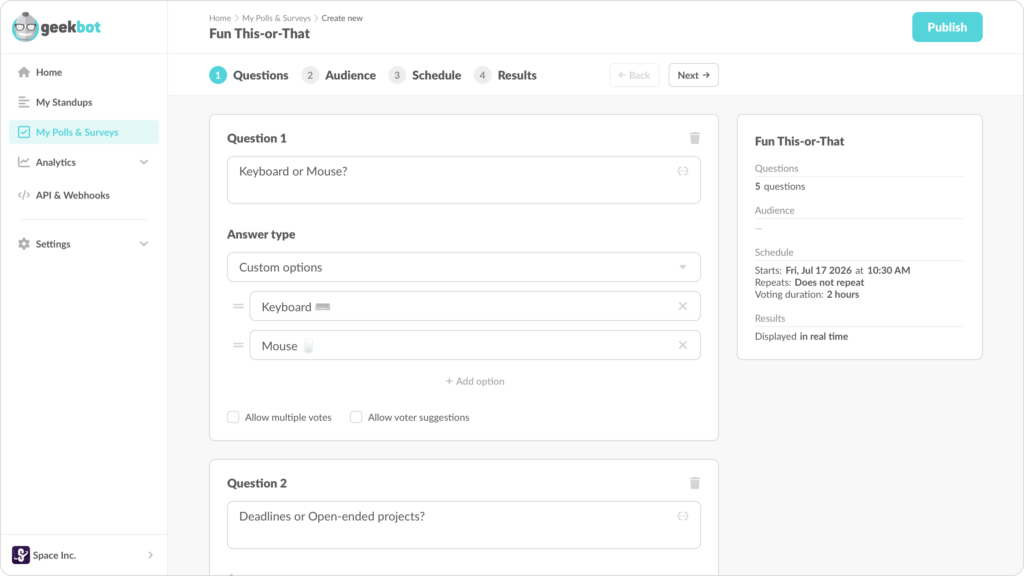
- Keyboard or mouse?
- Headphones or speakers?
- Multitasking or single-tasking?
- Deadlines or open-ended projects?
- Solo work or collaborative work?
- Detailed instructions or big-picture goals?
- Urgent meetings or scheduled ones?
- Brainstorm sessions or individual thinking time?
- Video on or camera off?
- Chat or calls?
- Unread badge on or off?
- Notification sounds or silent?
- Standing desk or sitting desk?
- Phone calls or text-based communication?
- Open office or private space?
- Inbox zero or controlled chaos?
- Strict schedule or flexible schedule?
- Long breaks or short breaks?
- Snacking at the desk or away from the desk?
- Task management tool or sticky notes?
- Dark mode or light mode?
- Pomodoro or continuous flow?
- Calendar blocking or spontaneous?
- Slack status updates or just assume?
- “Read receipts” on or off?
- Formal meetings or hallway chats?
- Planned sprint or continuous deployment?
- Debugging code or writing new features?
- Code review or merge and move on?
- Testing before launch or testing post-launch?
- Documentation first or write code first?
- Comments in code or self-documenting code?
This or That Questions for Remote Teams
This is where the magic happens. These questions are specifically designed for remote, async-first teams. They acknowledge the unique dynamics of remote work and permit people to be honest about their preferences.
- Async updates or live standups?
- Camera on or camera off?
- Slack huddles or Zoom calls?
- Home office or coworking space?
- Digital whiteboards or Google Docs?
- Time zone overlap meetings or pure async?
- Standing desk or desk treadmill?
- Separate office room or corner of the living room?
- Background blur or showing your space?
- Muted by default or unmuted by default?
- Chat during calls or no chat?
- Recording meetings or live only?
- Meeting notes in doc or video review?
- Scheduled 1-on-1s or drop-in chats?
- Recurring meetings or as-needed only?
- Company Slack or thread heavily or more isolated channels?
- Standing during calls or sitting?
- Morning standup or afternoon standup?
- Written updates or video updates?
- Daily check-in or weekly check-in?
- Quick coffee chat or longer scheduled 1-on-1?
- Distributed across time zones or clustered hours?
- Full remote or hybrid option?
- Company retreat quarterly or annually?
- Team bonding virtual or in-person?
- Flexible hours or core hours?
- PTO blackout dates or take when you want?
- Commute time saved or miss the office?
- Working from bed or working from a desk?
- Coffee shop or home?
- Pets on camera or pets off camera?
- Background noise allowed or a silent background?
- Side-by-side work or async collaboration?
- Scheduled breaks or natural breaks?
- Same-day response or next-day response expected?
- Always available or during office hours?
- Slack after hours or strict cutoff?
- Overlap time or total flexibility?
This or That Game Questions for Team Meetings
These are slightly more playful and work great for meetings where you want higher energy. They’re also perfect for workshops, all-hands meetings, or when you need to break the tension.
- Remote first or office first?
- Casual attire or business casual?
- Catered lunch or lunch stipend?
- Company car or car allowance?
- Gym membership or yoga classes?
- Mental health days or sick days?
- Wellness stipend or fitness classes?
- Conference budget or learning stipend?
- Equipment budget or home office setup?
- New laptop every 2 years or unlimited upgrades?
- Monitor setup or keyboard?
- Ergonomic chair or standing desk?
- Noise-canceling headphones or regular headphones?
- Dual monitors or single ultrawide?
Rapid Fire Round
Keep these fast and light for back-to-back questions:
- Pizza or tacos?
- Beach or mountains?
- Rain or snow?
- Dogs or cats?
- Early or late?
- Solo or group?
- Plan or improvise?
- Quiet or loud?
- Hot or cold?
- Sweet or savory?
- Movie or book?
- Airplane or road trip?
- City or country?
- Winter or summer?
Funny This or That Questions for Workplace Chats
These lean into the more playful side while still being workplace-appropriate. They’re good for Slack channels, virtual happy hours, or moments when the team needs a fun breather.
- Unlimited PTO or 4-day workweek?
- Free snacks or free coffee?
- Loud keyboard or noisy coworker?
- Memes or GIFs?
- Emojis or words?
- All caps or no caps?
- Exclamation points or periods?
- 😂 or 🤣?
- “lol” or “lmao”?
- React or reply?
- Threads or channel spam?
- Status update or vanish all day?
- Reply all or never?
- CC or BCC?
- Long emails or quick Slack messages?
- Read receipts on or live on the edge?
- Seen a message, but don’t respond immediately or respond right away?
- Leave team chat on mute or constant notifications?
- React to every message with emojis or never react and seem cold?
- Slack avatar selfie or cartoon?
- Formal display name or nickname?
- Status message updated or never touched?
- Slack themes or default?
- Light mode Slack or dark mode?
- Inline code or code block?
- Formatted message or rambling?
- Voice notes or text?
- Video message or call?
- GIF reactions or emoji reactions?
This or That Icebreaker Questions for New Employees
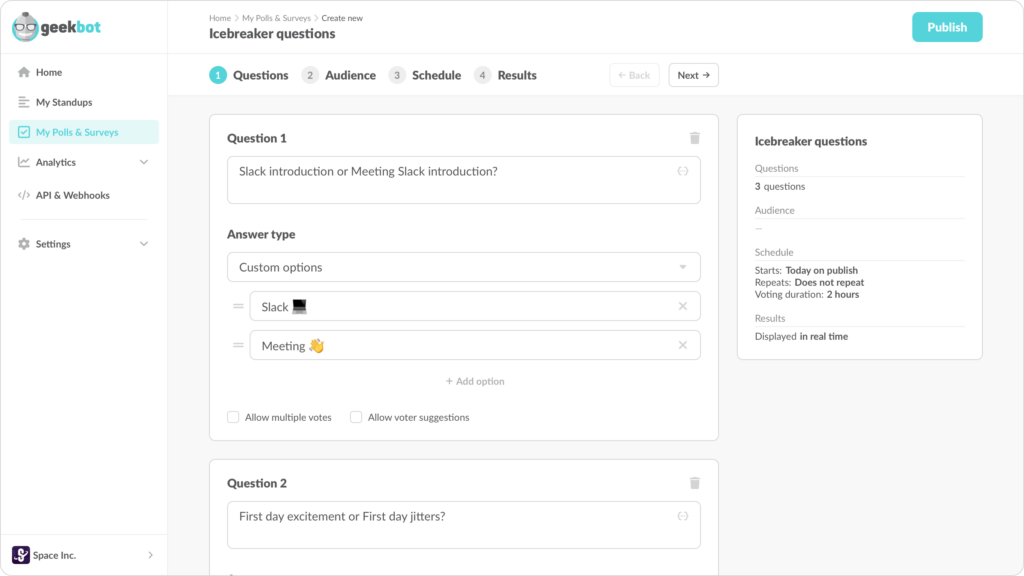
New hires sometimes feel a bit nervous. They don’t know the team dynamic yet, they’re worried about fitting in, and they’re evaluating whether they made the right choice in joining. A good icebreaker makes them feel like a part of the team, not like they’re being interviewed.
- First day excited or first-day jitters?
- Small team or large organization?
- Prefer clear structure or prefer flexibility?
- Like onboarding buddies or self-guided?
- Video intro with team or async intro?
- Team lunch on day one or settle in first?
- Jump into the project or shadowing first?
- Questions answered or figured out?
- Quick wins or complex problems?
- Working remotely forever or in an office eventually?
- Met the team before starting or starting on day one?
- Have you set up your workspace, or are you still setting up?
- Coffee chat with the manager first or straight to work?
- Handbook first or people first?
- Tools tutorial or learning by doing?
- Documentation first or ask as you go?
- Group introduction or one-on-ones?
- Slack introduction or meeting introduction?
- Lunch with the team or eating alone?
- Company-wide intro or team-level intro?
Slack-Friendly This or That Prompts
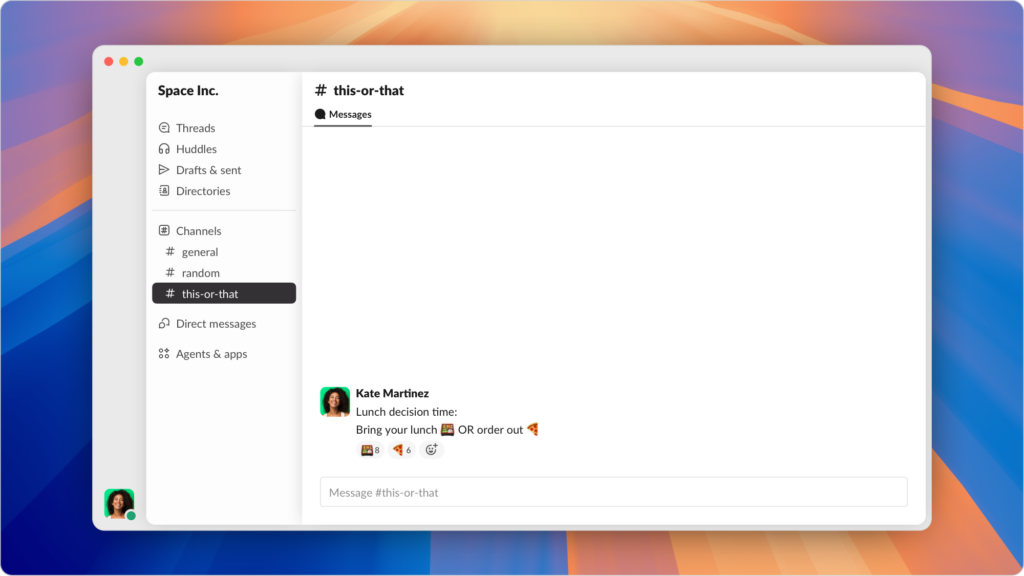
These are formatted specifically for Slack, with character limits in mind and emoji voting built in. Copy and paste them directly into your #random, #this-or-that, or company-wide channel.
- Quick this or that:
Remote forever 🌍 OR 4-day workweek 📅 - Today’s choice:
Coffee ☕ OR Tea 🍵 - Morning or evening person?
Early riser 🌅 OR Night owl 🌙 - Work style question:
Async updates 📝 OR Sync meetings 🎥 - This or that:
Background music while working 🎶 OR Complete silence 🤐 - Lunch decision time:
Bring your lunch 🍱 OR order out 🍕 - Time off preference:
Long vacation 🏝️ OR Frequent shorter breaks ✈️ - Work setup:
Standing desk 🏃 OR Sitting desk 🪑 - Project preference:
Deep focus work 🧠 OR Collaborative sprints 👥 - Communication style:
Voice messages 🎤 OR Text messages 📝
Quick This or That Questions for Daily Standups
These are specifically designed for the 30-second warm-up morale boosters at the start of your standup. Keep them light and snappy.
- Morning energy or afternoon energy?
- Inbox zero or controlled chaos?
- Deep work or collaborative sessions?
- Music while coding or silence?
- Multiple monitors or single screen?
- Dark mode or light mode?
- IDE or text editor?
- Debugging or new features?
- Meetings today or a focused day?
- Coffee count: one or three?
- Walk break or desk lunch?
- Shipped today or almost there?
- Quick win or progress on a big thing?
- Helped teammate or solo task?
- Learned something or reinforced knowledge?
- Bug found or bug fixed?
- Documentation or code?
- Tests passing or tests tomorrow?
- Merged or review queue?
- Confident about the sprint or nervous?
- Team energy high or rebuilding?
Seasonal & Holiday This or That Questions
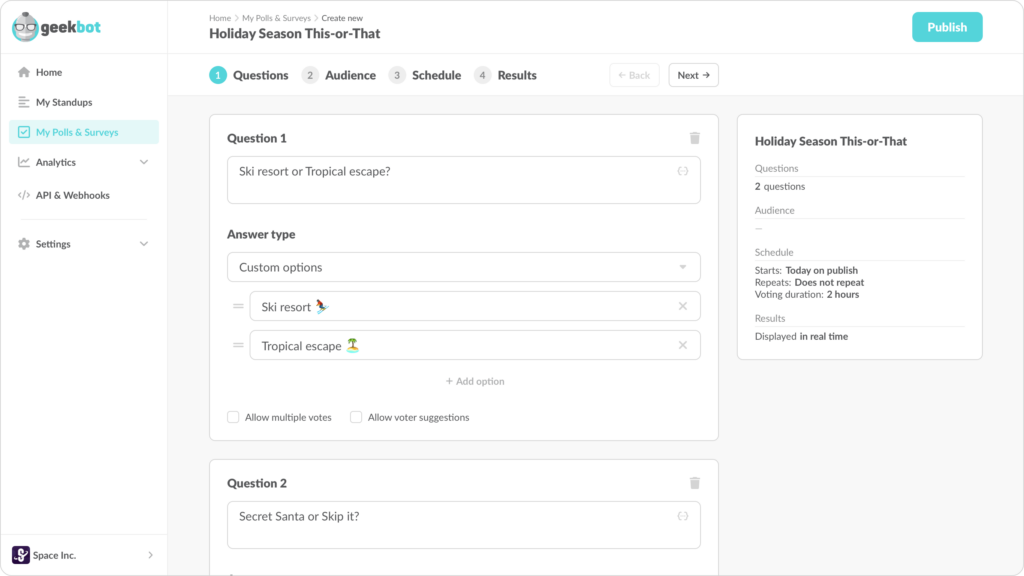
Are you fond of the winter holiday break, or are you a summer fanatic? No matter your preference, you can utilize all seasons to create fun and interesting this or that questions for your team!
Summer Questions:
- Summer Fridays or no special treatment?
- Beach vacation or mountain trip?
- AC blasting or windows open?
- Iced coffee or hot coffee?
- Early mornings or sleeping in?
- Sunrise or sunset?
- Pool or lake?
- Sandals or sneakers?
Fall Questions:
- Sweater weather or still hot?
- Pumpkin spice or regular coffee?
- Halloween costumes or skip it?
- Football or just for the commercials?
- Cozy indoors or crisp walks?
Winter Questions:
- Ugly sweater or normal sweater?
- Holiday parties or stay home?
- Snow or mild winter?
- Ski trip or tropical escape?
- Holiday music or not yet?
- Gift exchange or skip it?
Spring Questions:
- Spring cleaning or ignore the mess?
- Daylight saving or hate the change?
- Allergies or clear skies?
- Gardening or yard work?
- Spring break or work through?
Tips for Running Better Team Icebreakers
Here’s the thing: icebreakers often feel forced and awkward. But they can also be incredibly powerful if done right. And here’s how to maximize them.
Don’t Force Participation
This is rule number one. Icebreakers work because they’re low-pressure. The moment you make someone answer, you’ve defeated the purpose. In Slack? Let them react silently. In a meeting? Offer “pass” as an option.
Avoid Controversial Topics
Your icebreaker should unite, not divide. Avoid using subjects that involve politics, religion, sports rivalries, income, or family structures. Stick to preferences, not beliefs. “Coffee or tea” is safe. “Why is our country’s healthcare system broken?” is not.
Keep Questions Lightweight
Icebreakers are not therapy sessions. “What’s your biggest fear?” is not an icebreaker. It’s a vulnerability trap question. Stick to quick choices that reveal personality without requiring emotional labor.
Rotate Formats
If you ask “coffee or tea” every single day, it will stop working. Variety matters. Mix work-related questions with personal ones, rapid-fire with thoughtful, trivial with sincere. Rotation keeps them fresh.
Async Participation Improves Inclusivity
If you only ask icebreakers in meetings, you’re excluding introverts, people in different time zones, and people who need time to think. Use Slack for most icebreakers. Async-first is more inclusive by default.
Pay Attention to Answers
This is the secret move. When someone answers, acknowledge it. Reference it later. “Hey, I remember you said you’re a night owl. How are you handling these early meetings?” This turns an icebreaker into an actual connection. The question itself isn’t the power; noticing the answer is.
Include Diverse Categories
Mix personal questions, work questions, silly questions, and deep questions. People are multidimensional. Let them show different sides. Variety also appeals to different personality types.
Don’t Overuse Icebreakers
Icebreakers are a seasoning, not the meal. Every meeting does not need an icebreaker. Use them strategically. New team? Yes. Tense retrospective? Yes. Regular standup where people are already talking? Maybe once a week, not every day.

Frequently asked questions
What are good this or that questions for work?
Good this-or-that questions for work are lightweight, non-controversial, and reveal personality without requiring vulnerability. They should take less than 10 seconds to answer. Examples include "Morning or evening?", "Remote or office?", "Slack or email?", and "Planned or spontaneous?" The best questions feel natural to your team and culture.
How do you use this or that questions in team meetings?
Start your meeting with a this or that question as a 30-second warmup. Let people answer quickly—they can raise hands, shout out, or type in chat. Keep it moving. The goal is to shift people from status-update mode into conversation mode, so by the time you get to the real agenda, energy is higher. Use them once or twice per week, not every meeting.
Are this-or-that questions good icebreakers?
Absolutely. This or that questions are actually better icebreakers than traditional open-ended icebreakers because they're lower-pressure. No one feels put on the spot when you ask them to pick between two options. They're especially effective for new teams, new hires, and remote teams where vulnerability might feel unsafe. The low barrier to entry means more people participate.
What are fun this or that questions for remote teams?
The best this or that questions for remote teams acknowledge the realities of distributed work. Ask about async updates versus live standups, camera on versus camera off, Slack versus Zoom, home office versus co working space, and time zone preferences. These questions validate remote work preferences and signal that your team understands the unique dynamics of working distributed.
Can this or that questions improve employee engagement?
Yes. Engagement isn't just about productivity; it's about feeling seen and connected. This or that questions create small moments of humanity in an increasingly async world. They signal "we value your personality, not just your output." When deployed consistently, they build psychological safety, create connection, and make people feel like their whole self is welcome at work. That drives engagement up.
How many this or that questions should you ask in a meeting?
One or two, maximum. Any more than that and you're spending valuable meeting time on icebreakers instead of actual work. One quick question at the beginning does the job. If you want to do more, move them to Slack where people can answer async without eating into synchronous time.
Are this or that prompts good for Slack?
This or that prompts are perfect for Slack. They work in async contexts where people answer throughout the day. They're short enough not to overwhelm notifications. They drive engagement in channels. And they're easy to format for emoji reactions or quick replies. If you're looking to boost Slack engagement, this or that questions are one of the easiest, most effective ways.